18 Aug 2026
Tracing the Development of Early Probability Tables That Shaped Blackjack Decision-Making Frameworks
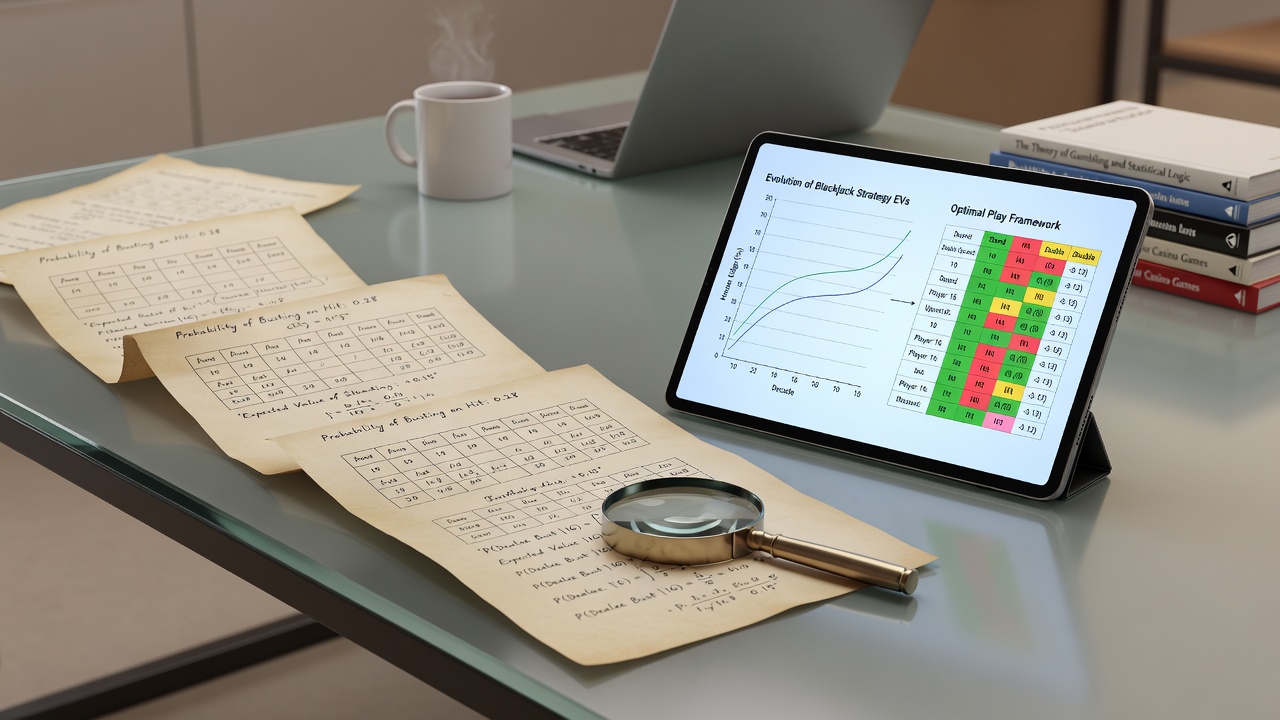
Probability tables for blackjack emerged from centuries of mathematical inquiry into chance and games of skill, and researchers applied systematic enumeration methods to card outcomes long before modern computing tools existed. Those who've studied this history note that the shift from general probability theory to specific decision frameworks for twenty-one occurred gradually through published works in the mid-twentieth century.
Seventeenth-Century Foundations in Chance Calculations
Mathematicians in France and elsewhere laid groundwork when Blaise Pascal and Pierre de Fermat exchanged letters on dividing stakes in interrupted games, and their correspondence established rules for expected value that later scholars extended to card decks. Gerolamo Cardano had already explored dice and card probabilities in the sixteenth century, yet his manuscripts remained unpublished until much later, so the 1654 correspondence gained wider attention among European scholars. Observers note that these early efforts focused on combinatorial counting rather than player decisions, yet they supplied the logical structure that allowed subsequent generations to tabulate blackjack scenarios.
By the eighteenth century, Abraham de Moivre refined these ideas in "The Doctrine of Chances," where he presented formulas for repeated trials that gamblers and analysts could adapt to multi-deck situations, and his tables of binomial probabilities influenced later writers who turned to specific casino games. Data from library records shows his book circulated among mathematicians across Britain and the continent, creating a shared reference point for anyone attempting to quantify card-draw sequences.
Nineteenth-Century Attempts at Card-Game Tables
Throughout the 1800s, several European writers produced limited probability tables for games resembling vingt-et-un, though most remained in private circulation or appeared only in gambling manuals printed in small editions. One researcher who examined French archives found handwritten sheets listing frequencies for initial two-card totals, yet these lacked the complete decision columns that would later define basic strategy. Academic sources such as the American Mathematical Society archives preserve correspondence from this period in which analysts debated whether to stand on totals of sixteen against certain dealer upcards, revealing that informal tables circulated among serious players decades before formal publication.
The 1956 Baldwin Group and Comprehensive Enumeration
Four researchers at the Aberdeen Proving Ground—Roger Baldwin, Wilbert Cantey, Herbert Maisel, and James McDermott—published the first peer-reviewed paper that delivered complete decision tables for blackjack in the Journal of the American Statistical Association. Their method involved exhaustive hand-by-hand calculation of all possible deck compositions, and the resulting tables specified when to hit, stand, double, or split under every dealer upcard. Figures from the paper indicate they evaluated more than 100,000 distinct situations by hand, an effort that took months and produced percentages accurate to within a fraction of a percent.
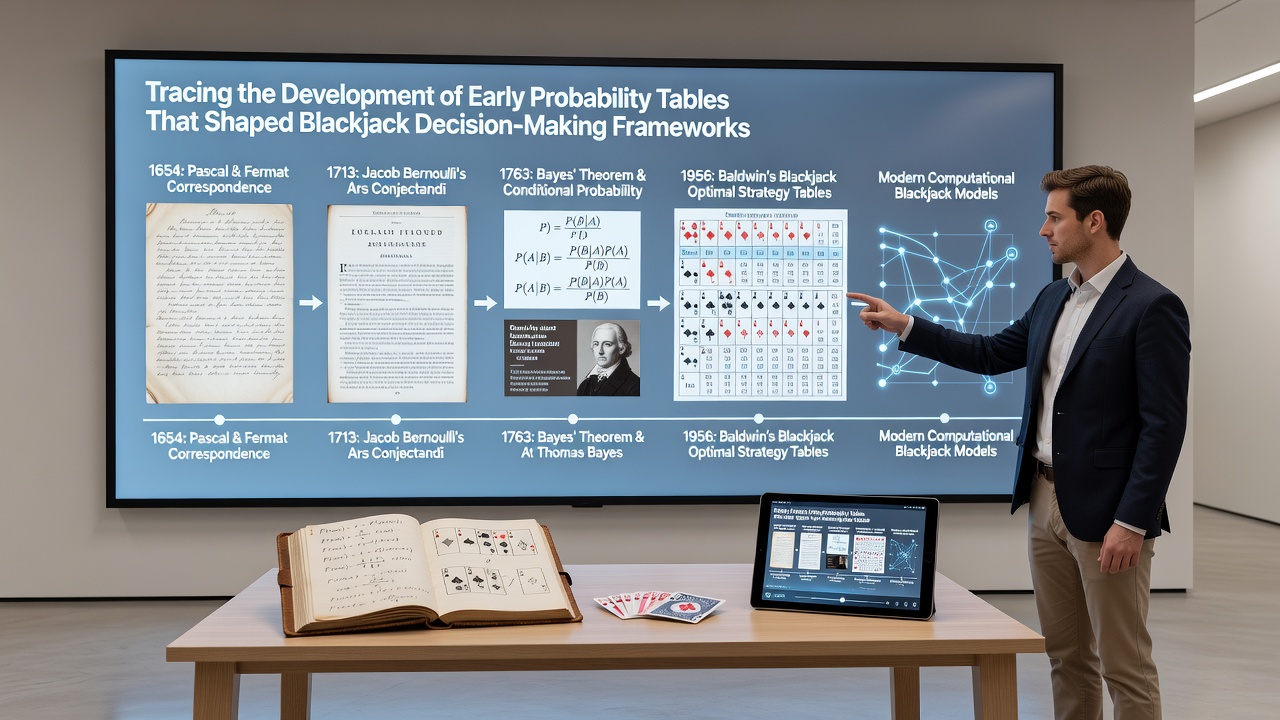
Because the authors released their full matrices rather than summary advice, later analysts could verify and extend the work without repeating the entire enumeration process. Government statistical agencies in the United States later referenced similar combinatorial techniques when studying lotteries, demonstrating how the blackjack tables contributed to broader methodological discussions.
Edward Thorp's Refinements and Published Strategy Cards
Edward Thorp, then a mathematics instructor, used early computers at MIT to test and adjust the Baldwin tables for multi-deck shoes and for variations in house rules. His 1962 book "Beat the Dealer" presented simplified versions of these tables alongside a point-count system that allowed players to track remaining high cards, and sales records show the volume reached academic and recreational audiences simultaneously. Thorp's work demonstrated that small adjustments to the 1956 matrices could shift expected returns measurably, prompting casinos to alter rules in response during the early 1960s.
Researchers at Canadian universities later replicated portions of Thorp's computer runs with independent decks to confirm the original percentages, and their findings aligned closely enough that the core decision points remained unchanged. By August 2026, digital archives of these early papers continue to serve as source material for statistical software that recreates the original enumeration logic.
Transition from Paper Tables to Algorithmic Models
Once electronic calculators became available, analysts converted the printed matrices into punch-card programs that could handle larger deck counts and rule variants without manual recalculation. Industry organizations such as the Gaming Standards Association documented how these converted tables entered training materials for dealers and supervisors, and the same data structures later migrated into early video blackjack machines. The progression shows a direct line from the 1956 hand calculations to the lookup routines embedded in contemporary gaming systems.
Conclusion
Early probability tables for blackjack therefore represent a cumulative effort spanning three centuries, from the combinatorial insights of Pascal and Fermat through the exhaustive enumerations of the Baldwin group and the computer-assisted refinements by Thorp. Each stage added precision to the decision columns that players still consult, and archival records confirm that the numerical relationships established in those first published matrices continue to underpin modern strategy references across multiple jurisdictions.