28 Jun 2026
Tracing Blackjack's Footprints in the Birth of Modern Probability Studies
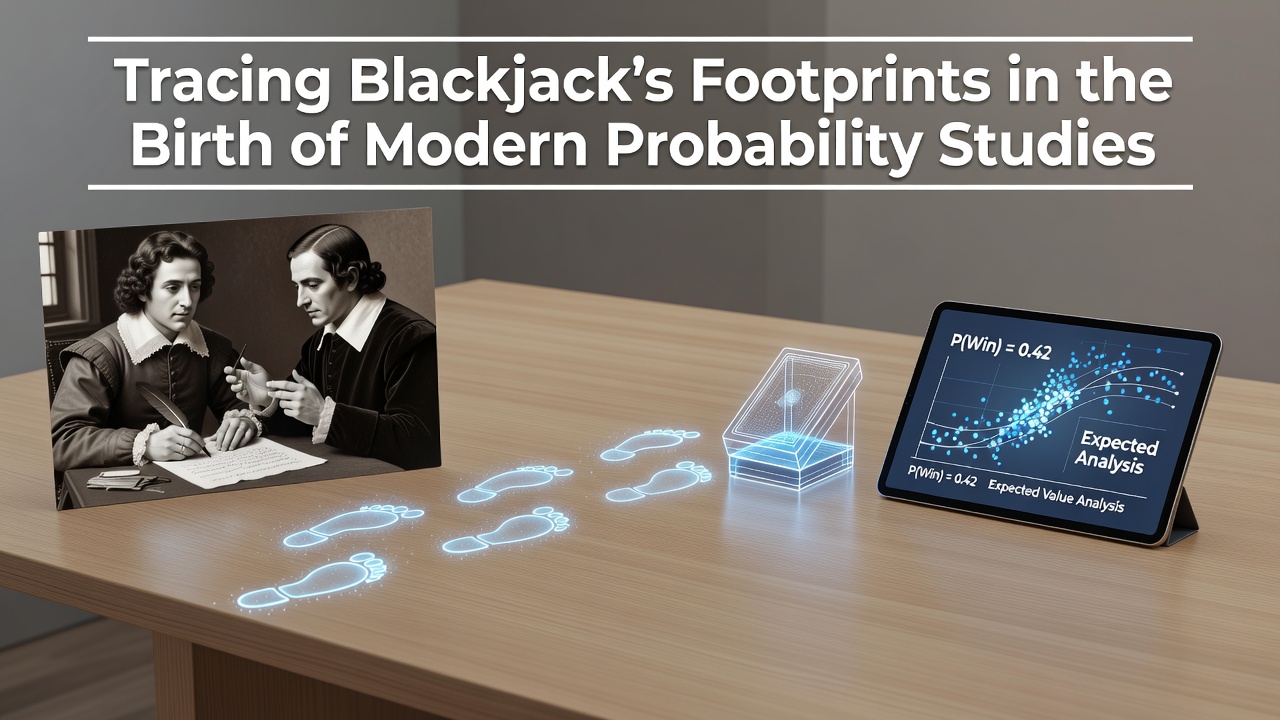
Blackjack emerged from earlier card games that relied on chance and player decisions, yet its mathematical structure connects directly to foundational work in probability theory. Observers note that problems arising from games of chance, including those resembling vingt-et-un, prompted systematic analysis of outcomes and odds during the 16th and 17th centuries. Researchers trace these connections through documented correspondence and treatises that shifted probability from intuition to formal mathematics.
Early Foundations in Games of Chance
Gerolamo Cardano examined dice and card probabilities in the 1500s, recording frequencies of various results in manuscripts that later influenced broader inquiries. His approach treated repeated trials as measurable patterns rather than isolated events, laying groundwork that later scholars extended to card combinations. Data from these early efforts showed consistent ratios across large numbers of plays, an observation that aligned with later binomial distributions used in blackjack strategy calculations.
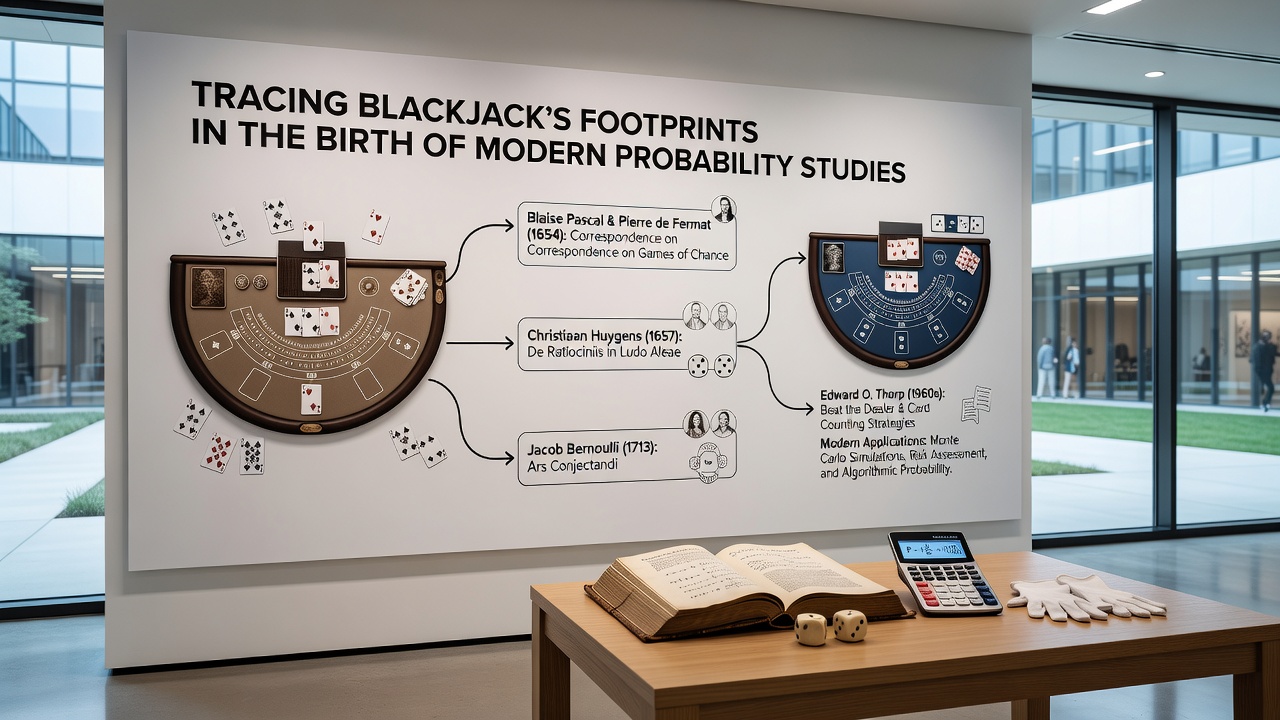
Cardano's notes on interrupted games also highlighted the need to divide stakes fairly when play stopped midway, a problem that resurfaced in correspondence between Blaise Pascal and Pierre de Fermat. Those letters addressed points awarded in unfinished rounds, establishing principles for expected value that apply equally to blackjack hands where decisions occur before all cards appear. Historians document how such exchanges moved probability into algebraic frameworks by 1654.
Card Combinations and Emerging Theory
Abraham de Moivre advanced these ideas in the early 1700s through work on card permutations and combinations. His Doctrine of Chances included tables for drawing specific sequences from decks, calculations that mirror teh combinatorial analysis required to evaluate blackjack probabilities for dealer upcards and player totals. Figures reveal that de Moivre's methods accounted for dependencies introduced when cards are removed without replacement, a feature central to multi-deck blackjack variants studied today.
Expansion Through the 18th and 19th Centuries
Jacob Bernoulli formalized the law of large numbers in 1713, demonstrating that observed frequencies approach theoretical probabilities as trials increase. This theorem underpins modern simulations of blackjack sessions that test basic strategy tables against millions of hands. Bernoulli referenced games of chance explicitly, noting their utility in illustrating convergence properties that hold across dice, cards, and other random processes.
Later contributors such as Pierre-Simon Laplace incorporated generating functions to handle more complex card scenarios. Laplace's Théorie Analytique des Probabilités applied these tools to problems involving sequential draws, patterns that researchers continue to adapt when modeling penetration effects and reshuffle frequencies in casino settings. Evidence from archival records shows Laplace drew examples from contemporary gaming practices without restricting his analysis to any single game.
Links to Statistical Methods
By the 19th century, probability theory had detached from its gaming origins yet retained core techniques developed through card problems. The central limit theorem, refined through contributions from several mathematicians, enabled approximations for sums of independent random variables, including those representing blackjack hand outcomes across repeated plays. Studies indicate these approximations remain accurate even when deck composition changes slightly between rounds.
Twentieth-century statisticians applied variance calculations and hypothesis testing to gaming data, confirming that deviations from expected returns follow predictable distributions. Government statistical agencies in multiple countries, including those tracking gaming revenues, have referenced similar frameworks when reporting long-term performance metrics. One such reference appears in documentation from Australian Bureau of Statistics analyses of chance-based activities.
Contemporary Applications and Research
Modern computational methods build directly on these historical foundations. Monte Carlo simulations, first conceptualized in the 1940s, replicate blackjack play at scale to quantify house edges under varying rulesets. Research institutions continue to publish refinements, such as updated combinatorial analyses for continuous shuffle machines. In June 2026 several academic departments plan joint workshops examining how early probability texts inform current algorithmic approaches to random number generation in digital card platforms.
University archives preserve original manuscripts that demonstrate explicit references to card games in probability derivations, underscoring the lineage from practical gaming questions to abstract theory. Those who've examined primary sources note repeated use of terms like "hazard" and "expectation" that persist in contemporary statistical literature.
Conclusion
Blackjack's structural elements, such as conditional probabilities and combinatorial choices, intersect with the same mathematical developments that produced modern probability studies. Records from multiple eras confirm that problems posed by card games supplied concrete examples for theorems now applied across sciences and engineering. This lineage remains visible in current research that cites historical gaming problems as entry points into rigorous statistical training.