2 Aug 2026
Mathematical Modeling of Blackjack Hand Frequencies Across Multi-Deck Configurations in Regulated Venues
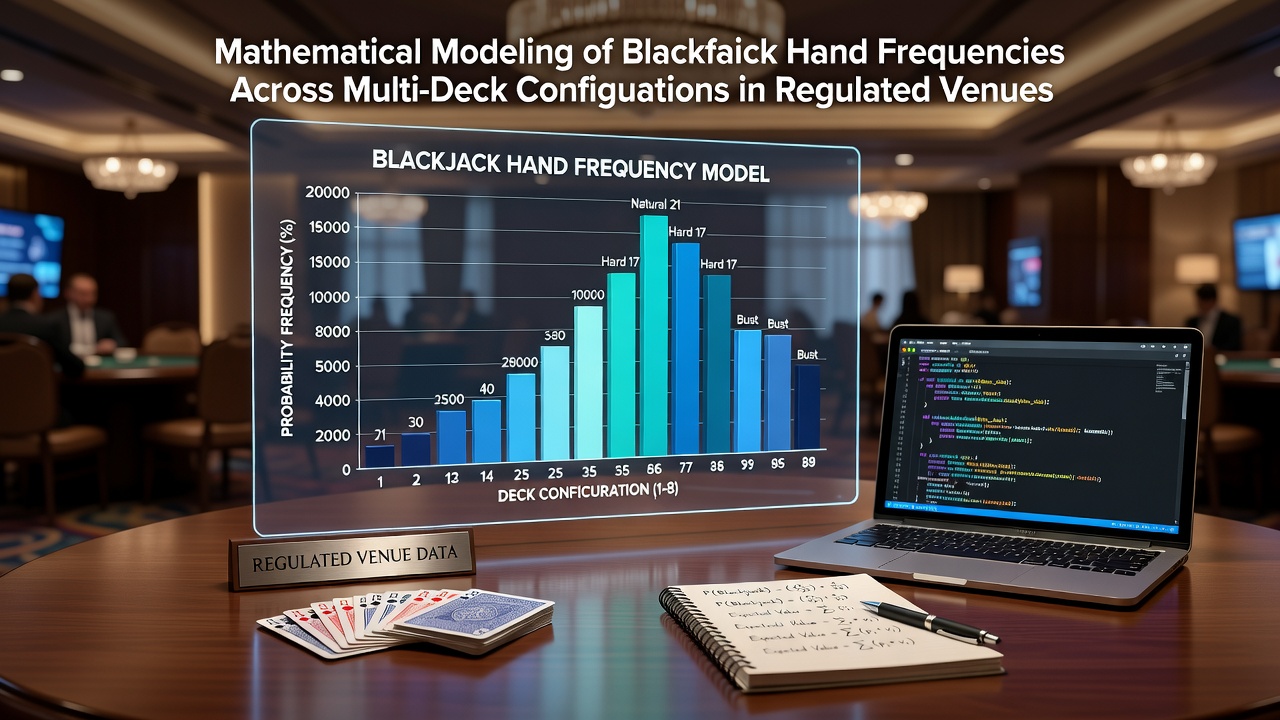
Mathematical models for blackjack hand frequencies rely on combinatorial analysis that accounts for the total number of decks in play, since each additional deck alters the probability space for card combinations drawn without replacement. Researchers apply hypergeometric distributions and exact enumeration techniques to calculate the likelihood of specific hands, such as blackjacks, pairs, and soft totals, across standard configurations that range from single-deck tables to eight-deck shoes commonly found in regulated venues.
Core Principles Behind Frequency Calculations
Combinatorial mathematics forms the foundation for these models, where the total possible hands equal the number of ways to select two cards from the remaining deck after accounting for initial removals, and frequencies shift because larger decks dilute the impact of any single card type. Data from multiple studies shows that the probability of an initial blackjack, which requires an ace paired with a ten-value card, decreases from approximately 4.83 percent in single-deck games to around 4.75 percent in eight-deck setups, while pair frequencies follow similar patterns due to the expanded card pool.
Regulated venues maintain strict rules on deck penetration and shuffle procedures that further influence these models, since continuous shuffling machines in some jurisdictions reset frequencies mid-shoe and require separate algorithmic adjustments. Observers note that software tools used by gaming laboratories simulate millions of hands to validate theoretical frequencies against observed outcomes, providing operators with precise benchmarks for compliance reporting.
Variations Across Deck Configurations
Single-deck and double-deck games produce higher variance in hand frequencies because depletion effects become pronounced after just a few rounds, leading to measurable changes in the distribution of remaining cards. In contrast, six-deck and eight-deck shoes maintain more stable frequencies throughout most of the shoe, which explains their prevalence in high-volume regulated environments where consistency supports both player expectations and regulatory oversight.

Take one analysis of four-deck configurations, which reveals intermediate frequency shifts where blackjack occurrences sit between single-deck and six-deck values, and this pattern extends to other hands such as 20-point totals or bust probabilities on dealer draws. Those who've examined regulatory filings know that venues must document their chosen deck counts and corresponding mathematical models when applying for or renewing licenses, since authorities require evidence that game parameters match approved specifications.
Implementation in Regulated Environments
August 2026 saw several North American gaming commissions update their review processes for blackjack modeling submissions, requiring operators to include sensitivity analyses that test how minor changes in deck composition affect overall hand distributions. These updates align with broader efforts to standardize reporting across jurisdictions, allowing cross-border comparisons of frequency data from sources such as the Nevada Gaming Control Board and reports issued by the Alcohol and Gaming Commission of Ontario.
Industry research organizations have compiled datasets that track real-world hand outcomes in multi-deck games, confirming that theoretical models closely match observed frequencies when shuffle integrity and card removal rules remain consistent. Experts have observed that deviations appear primarily when venues introduce rule variations, such as reduced blackjack payouts or altered doubling restrictions, which necessitate recalibration of the underlying combinatorial equations.
Conclusion
Mathematical modeling of blackjack hand frequencies continues to evolve alongside changes in deck configurations and regulatory requirements, delivering precise tools that support both operational decisions and compliance verification in regulated venues. Ongoing data collection from multi-deck environments ensures these models remain accurate reflections of actual gameplay conditions across diverse licensing jurisdictions.